
local SEO Strategies for Small Businesses
A small business owner reaches out to me with a good product, a decent website, a few customers who genuinely love what they do. Then someone nearby searches for exactly what that business sells, and it just doesn’t show up. Meanwhile the place down the street does, and it’s not necessarily better. It’s just easier to find.
Almost every time, that’s local SEO, or the lack of it.
I work in marketing and a big part of my job is helping small local businesses actually show up on Google. That means cleaning up Google Business Profiles that no one has touched in years, finding citations that are spread out in different directories, and creating content that focuses on specific neighborhoods instead of general industry words. It’s not exciting. It’s also much simpler than most people believe once you understand what is important and what is extra stuff.Digital marketing expert in thrissur
Here’s what I want to walk through: what actually works, a real client example, the one mistake I see constantly, and an honest answer to the question everyone asks eventually, how long is this going to take.
Why Local SEO Actually Matters
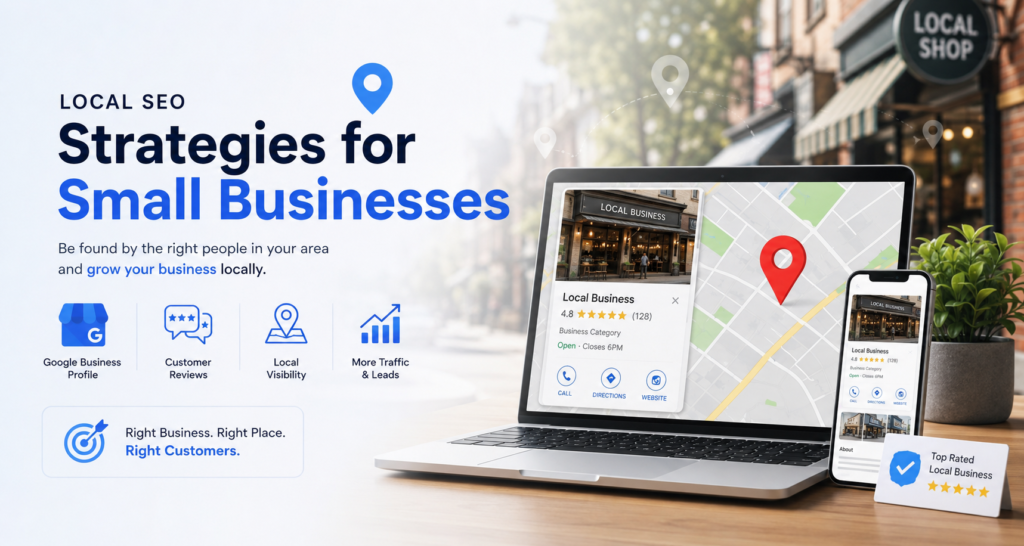
When someone searches for a plumber, a bakery or a dentist nearby, Google is not just looking at your website. Google is looking at your Google Business Profile, your reviews, whether your business details match everywhere they appear online, and how useful you look for that area. Local SEO helps you show up in those searches. Local SEO is a part of the online presence that lets customers find you easily.Local SEO Strategies for Small Businesses
Small businesses have a real edge here, if they use it. You’re not fighting thousands of companies across the country. You’re up against maybe five or ten businesses in your own neighborhood. Winnable, in other words, but only if you’re actually doing the things that decide who ends up at the top.local SEO Strategies for Small Businesses
What Getting It Right Actually Looks Like
I’ll skip the theory and give you a real case. A client came to me with a Google Business Profile that technically existed but hadn’t been touched in ages. We optimized it properly, fixed a batch of inconsistent citations that had been quietly confusing search engines, and added content built specifically around their location.
A few months later, they were ranking noticeably higher for the searches that actually mattered to them. Calls and inquiries through Google Search and Maps picked up too, enough that they noticed it themselves without me having to point it out. No ad spend involved anywhere. Just fixing what had been left alone for too long.local SEO Strategies for Small Businesses
That’s usually the pattern with local SEO. Rarely one clever trick. Mostly just clearing away whatever’s making it hard for people who are already searching to actually find you.
The Mistake I See Over and Over
If I had to pick the single biggest thing that trips up small businesses, it’s this: they build a Google Business Profile once, and then never open it again.
Hours change and nobody updates them. Reviews pile up unanswered. Photos are years old. Nothing gets posted, and the description was probably written in five rushed minutes the day the profile went live.
A Google Business Profile isn’t something you set up once and walk away from, it’s more like a storefront window. Let it sit neglected and people notice. So does Google.
If your profile hasn’t been touched in the last year, that’s probably not a coincidence. It’s likely a big part of why a competitor keeps beating you to the top.local SEO Strategies for Small Businesses
A Framework That Actually Works
Here’s roughly the order I follow when starting local SEO for a new client. Nothing secret about it, it’s just done thoroughly, in the right sequence.
Optimize the Google Business Profile
Categories, services, description, hours, photos, filled out completely. No shortcuts here.
Fix NAP Consistency
Name, address, and phone number need to match exactly, everywhere they appear online. Small mismatches confuse search engines far more than people expect.
Research Local Keywords
Not generic industry terms, the specific phrases people in your area are actually typing into Google.
Optimize Website Pages
Service and location pages should genuinely reflect where you work and what you actually do.
Build Location-Focused Content
Blog posts, service area pages, local guides, anything speaking to your real community instead of a generic reader.
Set Up a Review Generation Strategy
Genuine, ongoing reviews are one of the strongest local ranking signals out there, and they build trust before someone even picks up the phone.
None of these do much alone. It’s doing them together, consistently, that gets results.
So, How Long Does This Actually Take?
This is the question I hear most and I would rather answer SEO honestly than comfortably: local SEO is a long game. Not a quick fix and anyone claiming otherwise is leaving something out.
Most businesses start seeing movement somewhere between three and six months though that shifts depending on competition and location. A business in a suburb might see traction faster than a business fighting for space in a crowded city. Anyone promising rankings is either exaggerating or cutting corners that will cost you later.
What separates the businesses that succeed here from the businesses that give up is not speed. It’s whether they stick around past those first quiet weeks when nothing seems to be happening.local SEO Strategies for Small Businesses
What to Steer Clear Of
A handful of shortcuts worth avoiding entirely, because I’ve watched each one backfire:
Fake or Incentivized Reviews
Google catches these more often than people assume, and getting caught costs trust that’s hard to rebuild.
Mass Citation Submissions
Blasting your info to dozens of low-quality directories usually creates more inconsistency than it solves.
Keyword Stuffing
Jamming city names into every sentence makes content unreadable and can hurt rankings rather than help them.
Letting Your Profile Go Stale
Covered above already, but worth saying twice, it’s the mistake I run into most.
Frequently Asked Questions
How Much Does Local SEO Cost for a Business?
It depends a lot on whether you do it yourself or get help from an agency or a freelancer. The cost is not as important as the consistency you bring to it. Usually a small and steady effort works better than a one-time effort that doesn’t last.
Do I Need a Website to Rank?
It is helpful especially when you start using content that’s specific to a location, but a Google Business Profile that is well-optimized can still give a business real visibility and more inquiries even if the website is not very complete.
Can I Handle SEO Myself or Should I Hire Someone?
Plenty of the basics, filling out your profile, asking happy customers for reviews, are things you can do on your own. A specialist starts to make sense once you’re dealing with citation cleanup across a lot of directories, or need a content and keyword strategy running continuously in the background.
Is Local SEO Different From SEO?
Yes, local SEO is different from SEO and the difference matters a lot. Regular SEO focuses on ranking for terms often across the country or even worldwide. Local SEO on the other hand works for small businesses by targeting a specific location. It uses signals that regular SEO usually ignores, like Google Business Profile listings, local citations and content that connects to a neighborhood. This approach helps businesses show up when people nearby are searching for what they offer.
The Bottom Line
There is no method inside local SEO strategies for small businesses. It all comes down to things done regularly: a Google Business Profile that is complete and working, business details that are the same everywhere they are listed, reviews that are truly gained, and content that really connects with people in your local area.
It requires time, three to six months before real progress begins, but it grows. Businesses that keep working on it move away from the ones seeing this as a single task to check off.
If you take one thing away from this, go check your Google Business Profile right now. If it looks like nobody’s touched it in months, that’s exactly where to start.