If you’ve noticed your traffic behaving strangely over the past year or two, you’re not imagining it. AI Search has fundamentally changed how people find information — and it’s forcing marketers to rethink strategies that worked reliably for over a decade.
This isn’t another “SEO is dead” post. It’s a look at what’s actually changing, backed by real experience, and a practical way to adapt without throwing out everything you know about search.
What Is AI Search, Exactly?
AI Search refers to tools like ChatGPT, Perplexity, and Google’s AI Overviews that generate direct, synthesized answers instead of a list of blue links. Instead of clicking through to five different websites, a user gets one complete answer, often without visiting a single page.
That sounds convenient for users. For marketers, it’s a wake-up call.
The Moment the Shift Became Obvious
The biggest change I noticed firsthand was simple but significant: AI search tools started giving complete answers directly, cutting down the need to visit multiple websites. Readers no longer had to dig through ten tabs to piece together an answer — the AI did it for them.
That single shift changes the entire goal of content. It’s no longer just about ranking. It’s about being the source an AI trusts enough to reference, summarize, or recocomended.
How This Changes Digital Marketing Strategy
Traditional SEO focused heavily on keywords, backlinks, and rankings. AI Search in digital marketing rewards something slightly different: content that clearly and directly satisfies a real question.
In one project, the strategy shifted from targeting only SEO keywords to creating clear, question-based content that directly answers user intent. The result was more visibility inside AI-generated answers and noticeably better engagement from readers who found the content useful rather than keyword-stuffed.
This is the core lesson: rankings follow relevance, not the other way around.
Why Question-Based Content Performs Better
AI models are trained to extract clear, well-structured answers. Content that:
• Directly answers a specific question
• Uses plain, unambiguous language
• Is organized with clear headings
…is simply easier for an AI system to parse, trust, and surface. Vague, keyword-padded content tends to get skipped.
The Biggest Mistake Marketers Are Making Right Now
A common mistake is focusing only on keywords and rankings while ignoring user intent.
In AI Search, content that clearly answers real questions and provides genuine value is far more likely to be surfaced and recommended — regardless of how “optimized” it looks on paper.
If your content strategy still starts with “what keyword do we want to rank for” instead of “what is the reader actually trying to figure out,” that’s the first thing to fix.
A Practical Framework for AI Search Optimization
Here’s a simple, repeatable process for creating content built for both traditional search and AI Search:
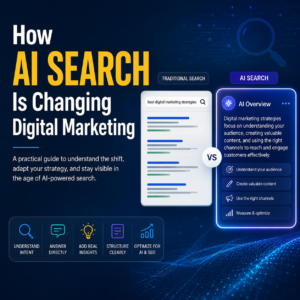
1. Understand user intent— What is the person actually trying to accomplish or learn?
2. Answer the question directly —Don’t bury the answer three paragraphs down.
3. Add real examples and insights — Experience is what separates useful content from generic AI-generated filler.
4. Structure it clearly — Use headings, short paragraphs, and lists so both readers and AI systems can parse it easily.
5. Optimize for search engines and AI tools together— Traditional on-page SEO still matters, but clarity and trustworthiness matter just as much.
This process improves both visibility and usefulness — which, in the AI Search era, are increasingly the same thing.
Where This Approach Has Limits
It’s worth being honest here: AI Search is constantly evolving, so what works today may change tomorrow. There’s no permanent playbook yet — the models and their ranking behaviors are still shifting.
It’s also worth noting that content lacking originality, expertise, or trustworthiness may struggle to appear in AI-generated results, even if it ranks reasonably well in traditional search. AI systems appear to weigh credibility signals differently than classic search algorithms, which means shortcuts that worked before are less reliable now.
In short: this approach isn’t a guaranteed formula, but a direction. Expect to keep adjusting.
Comparison: Traditional SEO vs. AI Search Optimization
Primary goal
Traditional SEO: Rank on page 1
AI Search Optimization: Be the trusted, cited answer
Content focus
Traditional SEO: Keyword targeting
AI Search Optimization: Direct intent-matching
Structure
Traditional SEO: Headings for skimming
AI Search Optimization: Headings for AI parsing
Success signal
Traditional SEO: Clicks, rankings
AI Search Optimization: Mentions, citations, engagement
Risk of shortcuts
Traditional SEO: Moderate
AI Search Optimization: High — content gets filtered out
FAQ
Does AI Search mean traditional SEO is no longer needed?
No. On-page SEO fundamentals — clear titles, structure, and technical health — still matter. AI Search adds a layer on top, rewarding clarity and trustworthiness even more heavily.
How long does it take to see results from this approach?
It varies by industry and content volume, but intent-focused content tends to show engagement improvements faster than ranking improvements, since it directly serves readers first.
Is AI Search the same across all platforms?
No — ChatGPT, Perplexity, and Google’s AI Overviews each have different sourcing and citation behaviors, so results can vary depending on where your audience searches.
Conclusion: Adapt, Don’t Panic
AI Search is changing digital marketing, but not by making good content obsolete — it’s raising the bar for what “good” means. The marketers who win here are the ones creating content that genuinely answers questions, backed by real experience, structured clearly, and built on trust rather than shortcuts.
Actionable takeaway: Before your next piece of content, ask one question first — “What is the reader actually trying to find out?” — and build everything else around answering that as clearly as possible.
Want to stay ahead of AI Search and future SEO trends? Visit our Digital Marketing Expert in Thrissur page for more insights, strategies, and marketing solutions.